|
|||||||||||||
|
|||||||||||||
 |


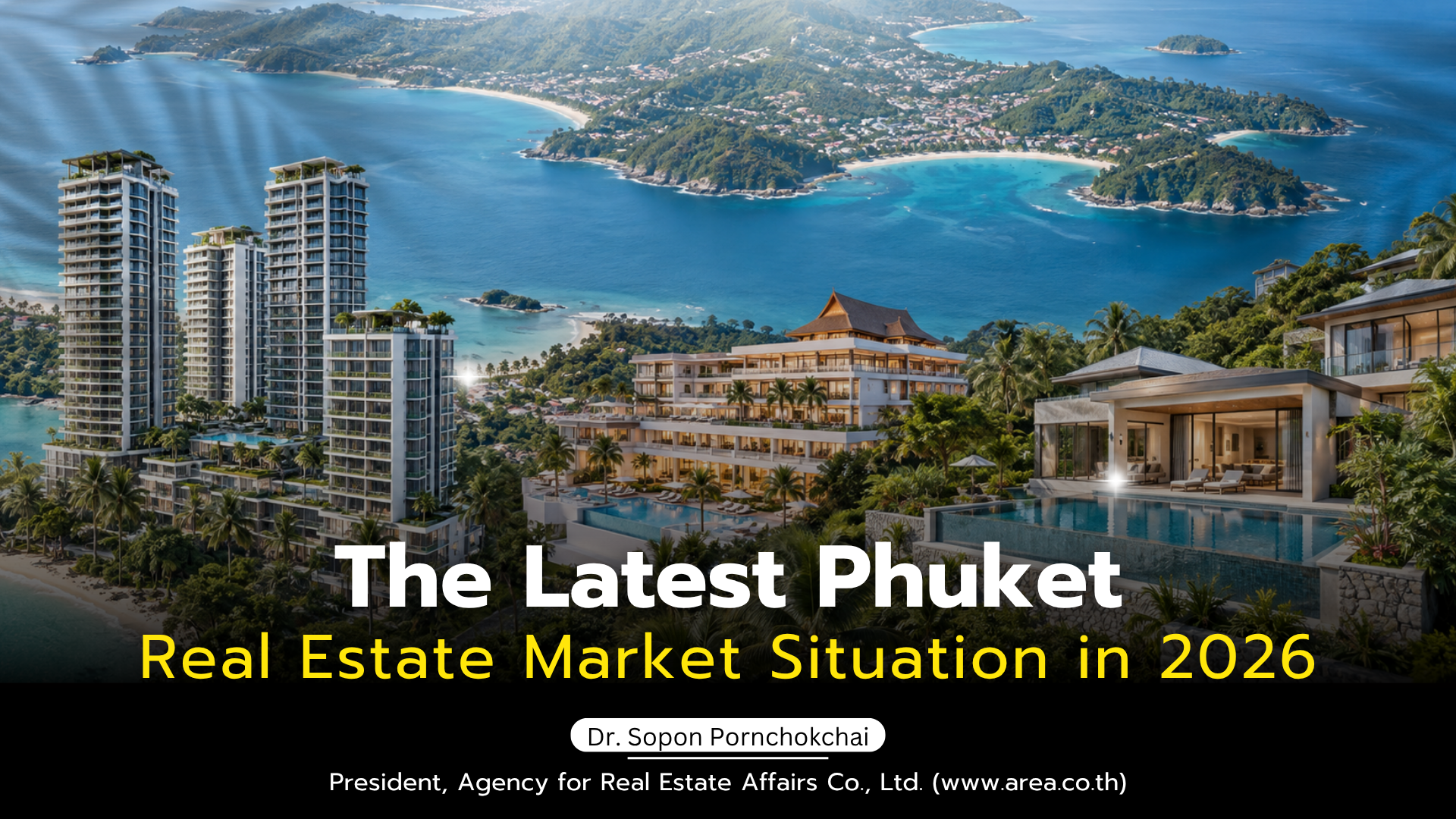
The Latest Phuket Real Estate Market Situation in 2026
AREA Press Release No. 1014/2026: September 21, 2026
Dr.Sopon Pornchokchai, Ph.D. Dip.FIABCI, MRICS
President, Agency for Real Estate Affairs (AREA)
In 2026, residential units offered for sale in Phuket had a total market value of THB 176.538 billion. Phuket ranked first among all 76 provinces outside Bangkok in terms of the value of residential properties for sale, exceeding Chonburi (THB 151.822 billion), Rayong (THB 51.453 billion), Thailand’s largest industrial hub, and Chiang Mai (THB 49.303 billion), the most important principal city in the North.
However, in terms of the number of units offered for sale in 2026, Phuket had a total of 13,779 units awaiting buyers, ranking behind Chonburi (37,628 units) and Rayong (19,209 units). Phuket nevertheless had the highest value of unsold inventory because its average selling price per unit was as high as THB 12.812 million. By comparison, the average selling price per unit in Bangkok was THB 5.808 million, while in Chonburi it was only THB 4.035 million.
A nationwide survey of provincial markets by the Thai Real Estate Research and Valuation Center, Agency for Real Estate Affairs Co., Ltd. found that Phuket differs from other provinces because it is a world-class tourism destination. International tourists recognize Phuket as one of the world’s major travel destinations, and tourism in Phuket generates substantial income for Thailand.
The residential property types surveyed by the Thai Real Estate Research and Valuation Center, Agency for Real Estate Affairs Co., Ltd. include detached houses, semi-detached houses, townhouses, shophouses, condominiums, and subdivided residential land. For Phuket, however, Dr. Sopon additionally classified resort condominiums and resort villas (which are not counted as detached houses). Buyers of the first six product categories are mainly Thai residents of Phuket or Thai people working in the province, while the latter two categories also target foreign buyers.
The latest survey found that Phuket still has 806 projects with units available for sale across Mueang Phuket, Kathu, and Thalang districts. Phuket has a large number of projects because individual project sizes are relatively small. On average, each project in Phuket has 112 units for sale, compared with approximately 250 units per project in Bangkok. Thalang has the largest number of projects, with 411, followed by Mueang Phuket with 281 and Kathu with 84.
Across the 806 projects, there are 90,597 units with a combined value of THB 705.055 billion. Of these, 76,582 units, worth THB 527.777 billion, have already been sold, equivalent to approximately 85%—a very high sales proportion. On average, about 5.2% of the units in each project are sold per month. Dr. Sopon estimates that the remaining inventory would be fully absorbed within 19.2 months if no new projects were launched.
The largest product category in Phuket is resort villas, with 40,263 units, equivalent to 44% of all units. When combined with another 6,830 resort condominium units, or 8%, resort-oriented properties account for 52% of Phuket’s total supply. Residential development for Phuket residents or Thai people working in Phuket therefore represents a smaller share than properties marketed to foreign buyers.
Among products primarily sold to Thai buyers, condominiums are the largest category at 21,392 units, or 24% of the total, followed by 9,729 townhouses. Phuket has 5,924 semi-detached houses, more than the 5,126 detached houses. Semi-detached houses require less land (minimum 35 square wah) than detached houses (minimum 50 square wah).
Of the total development value of THB 705.055 billion, resort condominiums account for THB 339.227 billion, followed by resort villas at THB 221.672 billion. Together, these two categories represent as much as 80% of all residential development value in Phuket. This shows that the market for Thai buyers accounts for only 20%. For Thai property developers, the domestic-buyer market is therefore relatively small compared with the foreign market.
The best-selling product category is residential condominiums, with monthly sales equivalent to approximately 8.1% of total units. Resort condominiums and resort villas sell at an average monthly rate of 4.9%, which is still substantial despite their high prices. Detached houses, semi-detached houses, townhouses, shophouses, and subdivided residential land sell at only around 3% per month. This indicates that the local market is fragile, and developers targeting Thai buyers face a relatively high risk of market contraction.
Key characteristics of each residential property type are as follows:
- The largest segment of detached houses is priced at THB 5–7 million, totaling 1,875 units or 37% of all detached houses.
- Nearly half of semi-detached houses (48%), totaling 2,821 units, are priced at THB 3–5 million.
- Most townhouses (68%), or 6,566 units, are priced at THB 2–3 million.
- Nearly half of residential condominiums, 44% or 9,481 units, are priced at THB 3–5 million.
- The largest segment of resort condominiums is priced at THB 3–5 million (29%), totaling 11,849 units. The second-largest segment is priced at THB 5–7 million, totaling 8,072 units or 25%.
- Nearly half of resort villas (43%), totaling 2,930 units for sale, are priced at THB 20–40 million.
By district, the survey found that:
- In Mueang Phuket District, the largest product category is residential condominiums, with 11,794 units or 34% of the total, valued at THB 29.006 billion. Resort condominiums number fewer units—10,987 units or 32%—but have a value of THB 69.922 billion.
- In Kathu District, residential condominiums form the largest category, with 6,940 units or 49% of the total. Although resort condominiums number only 4,282 units, their value reaches THB 32.498 billion.
- In Thalang District, resort condominiums are the largest category, with 24,994 units or 54% of the total, and they also have the highest combined value at THB 236.807 billion, or 53% of the district’s total.
The factors that have made Thalang District popular for purchasing residential properties, resort villas, and resort condominiums—particularly in Choeng Thale, Bang Tao, Layan, Si Sunthon, and Thep Krasattri—have turned the area into Phuket’s most popular hub for residential development and purchases. These factors combine location advantages, amenities, and the demographic profile of buyers, as follows:
1. Transportation and proximity to Phuket International Airport: Thalang is located in the northern part of the island, only 15–25 minutes from the airport. This is particularly convenient for foreign residents and investors who travel frequently and wish to avoid congestion in Phuket Town or the Patong area.
2. Large areas of flat land: Unlike Patong, Kata, or Karon, where much of the terrain is steep or constrained, Thalang still has large land parcels suitable for major low-rise developments such as resort villas or mixed-use communities.
3. Premium amenities and a lifestyle hub: The presence of Laguna Phuket in the Choeng Thale and Bang Tao area for more than 30 years has created international-standard infrastructure, including an 18-hole golf course, five-star hotels, and professional property-management services. Lifestyle and retail anchors include community malls and upscale lifestyle destinations such as Porto de Phuket (Central Group), Boat Avenue, and Blue Tree Phuket, making the area a modern lifestyle center.
4. Family-oriented infrastructure: The area is home to leading international schools such as UWC Thailand International School and HeadStart International School (Choeng Thale campus), as well as internationally accredited hospitals and clinics. This supports expatriate families seeking long-term relocation.
5. Nature and west-coast beaches with long, peaceful shorelines: Thalang includes several west-coast beaches such as Bang Tao, Layan, Surin, and Nai Yang. These areas offer beautiful sunset views, long sandy beaches, and a more private, green, and luxurious atmosphere than high-density tourist zones such as Patong.
6. Changes in foreign and investment demand driven by relocation: Since 2022, increasing numbers of buyers from Russia, Europe, Australia, China, and the Middle East have relocated to Phuket for long-term stays, continuously boosting demand for second homes and large resort villas.
7. Attraction created by leading developers: Major Thai national developers such as Sansiri, Supalai, Origin, and Singha Estate, together with local developers such as Botanica Luxury and The Title, have invested heavily and launched numerous projects in this area, further strengthening buyer and investor confidence.
8. High investment potential and returns: Resort condominiums and resort villas in the Choeng Thale–Bang Tao area generate average rental yields of approximately 6%–10% per year, supported by both short-term and long-term rental demand from high-end tourists.
New Projects Launched in 2025–2026
Newly launched projects have an average price of THB 10 million per unit. Most projects launched for sale (60%) are resort villa developments, with an average price of THB 32 million. In terms of the number of units developed, resort condominiums account for the largest share at 60%. Sales performance of these newly launched properties has been strong. The principal location for new launches is Thalang District, which comprises high-growth and high-priced locations. Thalang stands out as the district with by far the highest number of new project launches, distributed across five main subdistricts.
The principal target groups purchasing resort villas and resort condominiums in Phuket during 2025–2026 can be classified by buyer nationality as follows:
- Russian and Eastern European buyers (Russia & CIS Countries) remain the No. 1 foreign purchasing group in Phuket. Their reasons for buying include seeking refuge from geopolitical conflict and war, moving capital abroad for security, and escaping cold weather. They particularly favor resort villas in Thalang (Choeng Thale and Bang Tao), as well as Chalong and Rawai.
- Chinese and Asian buyers (China, Hong Kong, Singapore, Taiwan): This segment has recovered strongly and has high purchasing power. Key reasons for buying include diversifying financial risk arising from real estate problems in their home countries, sending children to international schools in Phuket, and purchasing condominiums and resort villas for rental to tourists from their own countries.
- Western European and Middle Eastern buyers (UK, Germany, France & Middle East): This is a high-quality, high-purchasing-power segment. Buyers seek retirement homes or winter holiday homes. Middle Eastern buyers are increasingly interested in large resort villas suitable for extended-family vacations.
- Thai buyers: This group accounts for approximately 15%–25% of the premium real estate market. Buyers are mainly affluent Bangkok residents purchasing second homes for recreation, investment diversification, and as assets to pass on to their children.
- Foreign demand for Phuket real estate is undergoing a structural shift from Phuket being merely a “seasonal holiday destination” to becoming an “international hub for long-term residence and investment.”
1. Demographic Shift
Strong growth among Indian and Middle Eastern buyers: Buyers from Middle Eastern countries such as the UAE and Saudi Arabia, as well as India, are playing a much greater role. Middle Eastern buyers favor luxury villas for large families, while Indian buyers prefer one-bedroom condominium units for investment and rental.
Europeans and Russians remain the core market: Russian and CIS buyers, together with Western Europeans from the UK, Germany, and Scandinavia, remain major sources of purchasing power. Their behavior is shifting from short-term holidays toward long-stay relocation to avoid geopolitical conflict and unfavorable weather conditions.
Younger Buyers: Digital nomads, technology entrepreneurs, and younger investors with high remote-work incomes (High-Income Remote Workers) are purchasing real estate as second homes where they can live and work simultaneously.
2. Preferred Property Types and Locations
Branded Residences & Wellness Living: Condominiums and villas offering five-star hotel-level services, as well as health-focused developments (Eco & Health-conscious), are highly popular because they provide confidence in management quality and service standards.
THB 30–50 Million Resort Villas (Mid-to-High Luxury): This is the principal price range receiving the strongest response from foreign buyers.
Expansion toward central and eastern areas: Development land along the west-coast beach areas, such as Bang Tao, Choeng Thale, and Kamala, has become increasingly scarce and much more expensive. Developers and foreign buyers are therefore moving toward quieter peripheral areas such as northern Thalang, Si Sunthon, Mai Khao, Pa Klok, and Chalong.
Infrastructure development: The new phase of Phuket International Airport expansion and improvements to the road transportation network are increasing the island’s capacity to accommodate travel.
Rental yields are expected to remain high, at approximately 6%–8% per year.
——————
Dr. Sopon Pornchokchai
Dr. Sopon is an expert in property valuation and has been invited to lecture on real estate at bachelor’s, master’s, and doctoral levels in Thailand and abroad. He has served as a consultant to ESCAP, UN-Habitat, the World Bank, and other international organizations. Dr. Sopon earned a Doctor of Science degree in Land and Housing from the Asian Institute of Technology (AIT). He received training in property valuation from LRTI - Lincoln Institute of Land Policy and in housing development from Katholieke Universiteit Leuven (Belgium).
He currently serves as President of FIABCI-Thai; Chief Executive Officer of the Thai Appraisal & Estate Agents Foundation; President of the Thai Real Estate Research and Valuation Center, Agency for Real Estate Affairs Co., Ltd.; Director of the Thai Real Estate Business School and the Home Buyers Association; representative of the International Association of Assessing Officers in Thailand; member of the Global Valuation Forum of The Appraisal Foundation (USA); and Vice President of the Employers’ Confederation of Thailand.
His major research and survey achievements include identifying 1,020 slum communities (1985); developing a CAMA (Computer Assisted Mass Appraisal) model for property valuation (1990); accurately forecasting 300,000 vacant housing units (1995 and 1998); studying the establishment of a National Real Estate Information Center (2000); developing a land valuation model (2002); establishing professional property valuation standards in Vietnam as a consultant to Vietnam’s Ministry of Finance (2006); serving as a consultant to Indonesia’s Ministry of Finance (2008); working on a World Bank expropriation project in Jakarta (2010); serving as a consultant to Cambodia’s Ministry of Finance (2012); conducting the ASEAN Real Estate Survey (2015); undertaking a Global Cities Study (2015); working on the relocation of Bangkok Zoo (2019); valuing 28 dams in Laos (2024); and serving as a consultant to the Asian Development Bank (2026).