Summary of the Presentation of AOTS Speakers
AREA Press Release No. 1227/2026: November 09, 2026
Dr.Sopon Pornchokchai, Ph.D. Dip.FIABCI, MRICS
President, Agency for Real Estate Affairs (AREA)
During October 26 to 30, 2026, Dr.Sopon Pornchokchai, President, Agency for Real Estate Affairs and Vice President, Employers Confederation of Thailand we to the Association for Overseas Technical Cooperation and Sustainable Partnerships (AOTS) for a training on Employment in Japan. This is the summary of the presentation.
Summary of the Presentation of AOTS Speakers
Dr.Sopon Pornchokchai
Vice President, Employers’ Confederation of Thailand
President, Agency for Real Estate Affairs
With the uses of AI, this is a summary of the presentations of speakers involved during the AOTS Training, October 26-30, 2026. Thank you very much for letting me join it. Hope to meet you all somewhere and sometime.
The Importance of Labor Research and Dissemination
Author/Presenting Organization: Japan Institute for Labour Policy and Training (JILPT)
The presentation outlines the roles and functions of the Japan Institute for Labour Policy and Training (JILPT), an incorporated administrative agency operating under the supervision of Japan's Ministry of Health, Labour and Welfare (MHLW). JILPT supports evidence-based labor policymaking through research, policy impact evaluation, information collection and analysis, dissemination of research findings, and training to strengthen administrative capacity. Its activities connect government policy priorities with the practical experiences of employers, workers, the public, and research partners.
Labor policy research is organized into three approaches: long-term research projects addressing structural labor policy issues, commissioned studies responding to the Ministry's priority policy needs, and urgent surveys providing rapid data collection and analysis. Research priorities for fiscal years 2022–2026 cover labor markets and social safety nets, career development and occupational structures, human resource development and technological innovation, diverse human resources and their activities, and diverse working styles, personnel treatment, and work rules. Through these activities, JILPT facilitates the continuous exchange of information between research and policy implementation, using evidence to inform practical decisions and identify new research questions.
Trade Union Activities in Japan and International Trade Union Networks
Author: Mr. Hitoshi Suzuki
Position: Deputy Secretary General, Japan International Labour Foundation (JILAF)
The presentation examines Japanese trade union activities and international labor networks, highlighting JILAF's initiatives to promote constructive industrial relations, prevent labor disputes, improve productivity, and support the formalization of informal workers. Major challenges include weak union leadership, limited knowledge of labor rights, employer and political interference, and inadequate dialogue. Japan's industrial relations system combines collective bargaining with labor-management consultation, emphasizing employment stability, improved working conditions, and fair distribution of productivity gains.
Japan has approximately 68.28 million workers and 9.927 million trade union members, while the unionization rate declined from 55.8% in 1949 to 16.5% in 2022. Average annual wages in Japan reached approximately USD 40,000 in 2021, remaining below those of several other G7 countries. The Japanese Trade Union Confederation (RENGO) actively participates in consultations with government institutions and economic organizations to improve labor policies and strengthen cooperation among employers, workers, and policymakers.
ESG Management and Human Capital Management: Initiatives of Japanese Companies
Author: Mr. Kazuteru Kuroda
Position: Senior Consultant, Japan Productivity Center
The presentation examines Environmental, Social, and Governance (ESG) management and human capital management practices in Japanese companies. It introduces the United Nations Global Compact and the six Principles for Responsible Investment (PRI), emphasizing the integration of environmental protection, social responsibility, and corporate governance into business strategies. Case studies of Kao Corporation and Fast Retailing demonstrate how Japanese companies incorporate ESG principles into corporate operations, sustainability initiatives, responsible supply chains, and long-term business development.
The presentation also highlights human capital management as a key component of corporate sustainability, focusing on employee development, diversity, leadership, productivity, and workforce well-being. It introduces ISO 30414:2018 and the U.S. SEC's human capital disclosure requirements, emphasizing transparency in workforce reporting. Examples from Sojitz Corporation and Hitachi illustrate corporate approaches to human capital disclosure and ESG performance monitoring, linking workforce management with sustainable business growth.
Current Labor Market Situations in Japan
Author: Prof. Mitsuhide Shiraki, Ph.D.
Position: Professor Emeritus, Waseda University, Tokyo, Japan
The presentation examines Japan’s labor market challenges, particularly population aging, declining birth rates, and changes in employment patterns. Japan’s total fertility rate fell to 1.15 in 2024, while the proportion of people aged 65 and above is projected to reach 36.4% by 2050. The lecture highlights the employment and pension systems, increasing participation of women and older workers, and the growing share of non-regular employment. It also discusses unemployment trends, job availability, and difficulties in retaining young employees.
The presentation further explores wage differences by education and employment status, long working hours, workforce development, and the increasing presence of foreign workers. Key policy issues include overtime restrictions, mandatory rest intervals between working days, fair treatment of regular and non-regular employees, and support for workers with family caregiving responsibilities. These measures address Japan’s changing workforce structure, labor shortages, employment stability, and the challenges of maintaining productivity and social protection in an aging society.
Recent Labour Market Conditions in Asian Countries: Similarities and Differences with Japan
Author: Prof. Mitsuhide Shiraki, Ph.D.
Position: Professor Emeritus, Waseda University, Tokyo, Japan
The presentation examines major labor market challenges across Asian countries, highlighting the rapid expansion of gig work, inadequate social protection, and the growing need for reskilling and upskilling due to digitalization and artificial intelligence. Other key concerns include widening skills and wage gaps in Thailand and Vietnam, heat-related occupational risks in India, the expansion of informal employment in Bangladesh, migration and workplace safety issues in Malaysia, and labor-management relations in the Philippines. Population aging and talent shortages are also emerging concerns in Thailand and Pakistan.
Comparing these challenges with Japan, the presentation identifies common issues arising from demographic changes, technological transformation, and workforce development. Japan faces population decline, an aging workforce, rising wages, labor shortages, and increasing numbers of employees leaving their jobs to care for family members. While labor market challenges are broadly similar across the region, urban informal employment and unstable labor-management relations are not considered major current issues in Japan. The comparison highlights both shared regional concerns and differences in national labor market conditions.
Trends and Challenges of Japanese Trade Unions from Workers’ Perspectives
Author: Mr. Fujikazu Suzuki
Position: Coordinator, Research Center for Solidarity-based Society, Institute of Labour Education and Culture (ILEC), Japan
The presentation examines the structure, functions, and challenges of Japanese trade unions, emphasizing enterprise-based unions, decentralized collective bargaining, and coordinated wage negotiations through the annual Shunto campaign. As of 2025, Japan had approximately 9.93 million union members, representing 16% of employees. Despite their historical contributions to labor-management cooperation, productivity improvement, and fair wage distribution, unions face declining membership, stagnant wages, changing employment structures, and reduced worker participation. The growing organization of part-time workers offers opportunities for union revitalization.
The presentation also explores trade unions’ responses to globalization, expanding international supply chains, and emerging forms of employment, including gig and freelance work. It highlights global framework agreements, corporate social responsibility, and cooperation with employers to protect labor rights internationally. Japan's largest trade union confederation, RENGO, promotes social dialogue, employment protection, and collaboration with civil society. Experiences during the COVID-19 pandemic demonstrate the importance of collective action, worker consultation, and stronger corporate democracy in addressing future labor challenges.
Labor-Management Relations with Consideration for Business and Human Rights
Author: Mr. Yoshihisa Masaki
Position: Director, Social Communication Bureau, Japan Business Federation (Keidanren)
The presentation outlines the role of the Japan Business Federation (Keidanren) in promoting responsible corporate management, constructive labor-management relations, and respect for human rights. Keidanren supports policy advocacy, stakeholder dialogue, and corporate self-regulation through its Charter of Corporate Behavior. The presentation emphasizes integrating sustainability and human rights into business strategies to manage risks, strengthen competitiveness, and build stakeholder trust. It also highlights the challenges and opportunities associated with international trade standards and responsible supply chains.
The presentation further examines Japan’s initiatives on business and human rights, including government guidelines, Keidanren’s implementation guidance, and the UN Guiding Principles on Business and Human Rights. Key measures include establishing human rights policies, conducting human rights due diligence, identifying risks across global supply chains, and providing effective grievance and remediation mechanisms. Corporate survey findings demonstrate progress in adopting human rights policies and training, while emphasizing continued implementation and cooperation with stakeholders to protect workers and vulnerable groups.
Initiatives by Japanese and Overseas Companies to Improve Workplace Environments
Author: Ms. Miwako Nagasu
Position: Lecturer, International Center, Keio University, Japan
The presentation examines occupational safety and health (OSH) initiatives in Japan and overseas, emphasizing workplace improvements, accident prevention, and productivity enhancement. It introduces the ILO's recognition of a safe and healthy working environment as a fundamental right, alongside participatory training approaches such as WISE, WISER, and POSITIVE. Key areas include occupational safety management, risk assessment, materials handling, workstation design, environmental protection, and employee welfare. The OSH Management System (OSHMS) applies the Plan-Do-Check-Act cycle, with reported workplace accident rates 37% lower in workplaces implementing OSHMS activities.
The presentation highlights practical workplace improvements through low-cost solutions, employee participation, checklists, and continuous improvement activities. Japan's Nissho Automobiles demonstrates effective workplace organization and productivity practices, while training programs in Lebanon and India illustrate improvements in safety awareness, working conditions, and employee engagement. The Indian POSITIVE program trained 26 trainers who subsequently conducted workshops for 476 co-workers. Further examples from 2023 workshops in Asian countries emphasize participatory learning, knowledge sharing, and sustainable workplace improvements through collaboration between workers and management.
Additional
In front of the AOTS:
https://www.facebook.com/share/r/1FM3iF1dGD/

Centre of Kita-Senju, Adachi City, Tokyo, Japan at a rainy evening
https://www.facebook.com/share/v/1DsL4Vt3fu/

Lives on Tokyo Trains, October 28, 2026
https://www.facebook.com/share/r/1ER4Y4dWF1/

Responsible Construction to the Pedestrians in Japan.
https://www.facebook.com/share/r/14sL9RWXAVH/

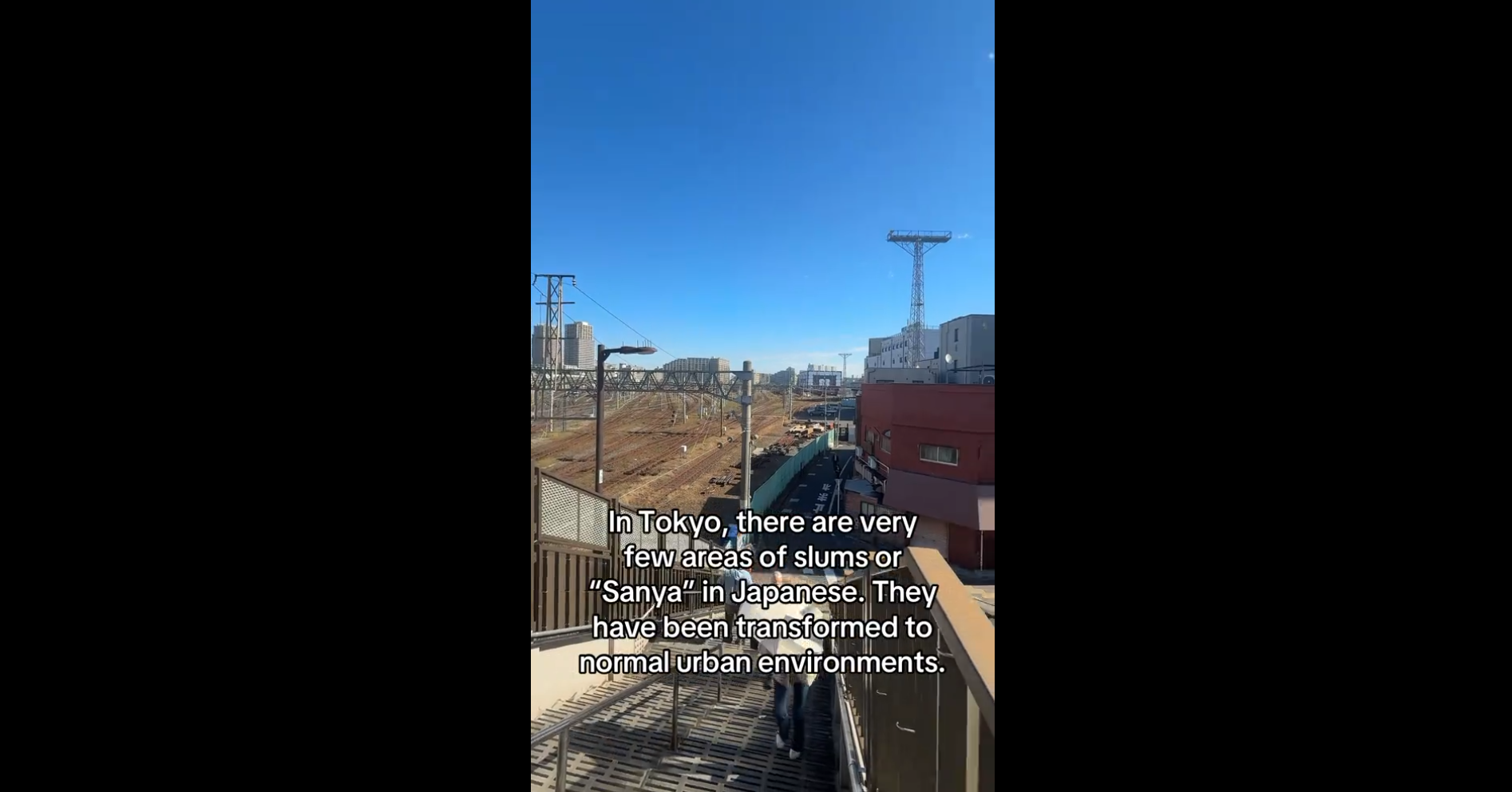
In Tokyo, there are very few areas of slums or “Sanya” in Japanese.
https://www.facebook.com/share/v/1PNv6YAa7E/