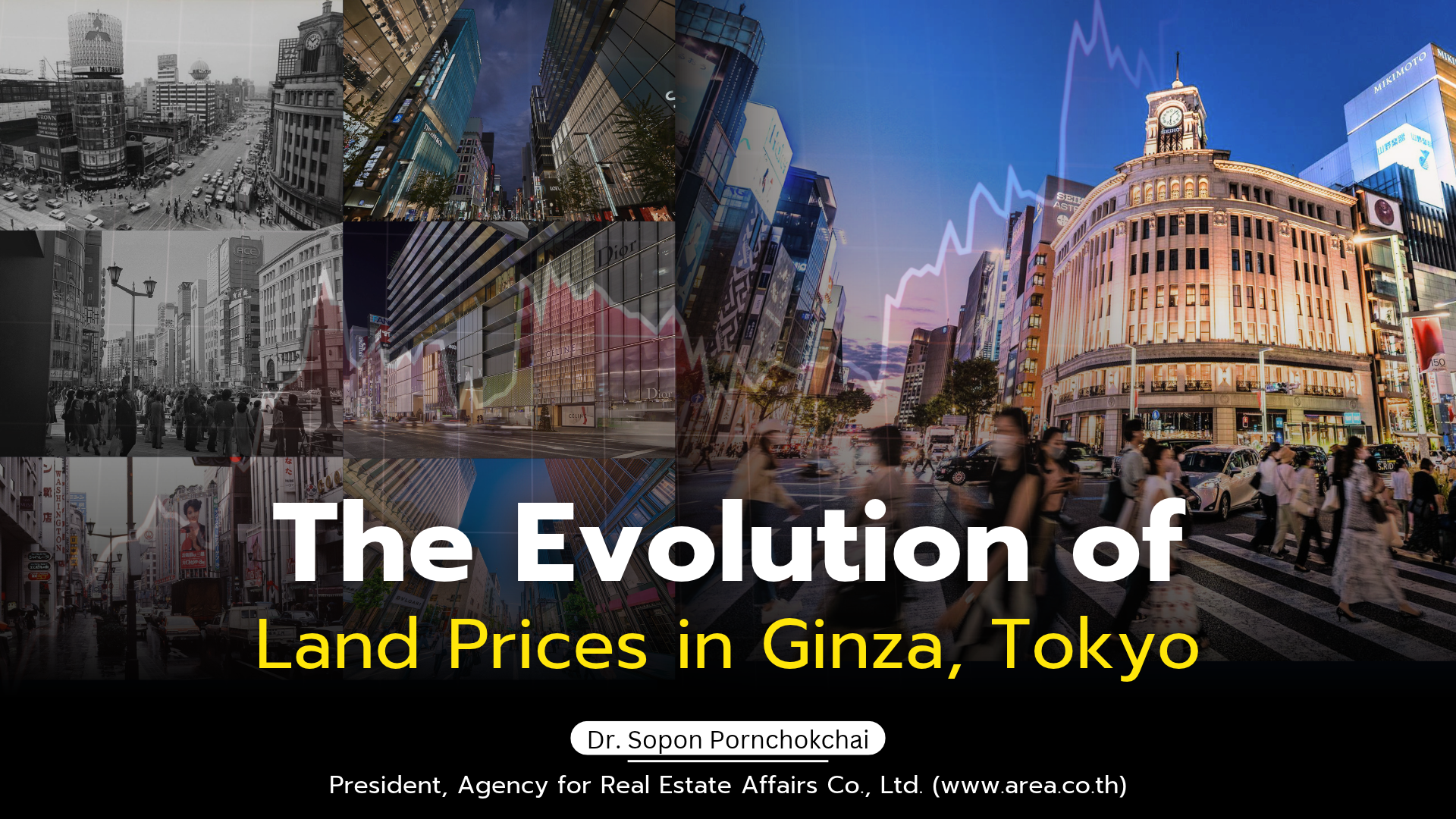
The Evolution of Land Prices in Ginza, Tokyo
AREA Press Release No. 1244/2026: November 12, 2026
Dr.Sopon Pornchokchai, Ph.D. Dip.FIABCI, MRICS
President, Agency for Real Estate Affairs (AREA)
Ginza is the area with the highest land prices in Tokyo, Japan. How have land prices in this district fluctuated? How do they compare with the highest land prices in Thailand? And what lessons can we learn from the experience of land prices in Ginza?
Dr.Sopon Pornchokchai, President, Agency for Real Estate Affairs went to Tokyo on February 5–6, 2025. On this occasion, he would like to share the lessons that can be drawn from changes in land prices in the Ginza district. Dr. Sopon has been compiling data on land-price movements in this area since 1994.
Ginza is renowned for its many luxury shops and is regarded as one of the world's most expensive commercial districts, according to Wikipedia. The area was originally a marshland, which was reclaimed during the sixteenth century. In 1612, during the Edo period, a mint was established there, giving the district its name, Ginza. Following a major fire in 1872, the Meiji government designated Ginza as a model for modernization. Plans were made to construct fire-resistant brick buildings and broad streets connecting the district with Shimbashi railway station. Western-style buildings were erected, although few remain today. Ginza consequently became home to numerous Western-style shops.
During the Great Kanto Earthquake of 1923, Ginza was once again devastated. The district was subsequently rebuilt, with major shopping centres and numerous luxury retail stores emerging. Entertainment venues and restaurants also became widespread. During the Second World War, however, Ginza was bombed by the Allied forces. After the war, businesses gradually reopened and re-established themselves in the area. From 1966 onwards, a number of buildings that are familiar landmarks today were constructed, including the Toshiba Building, Ginza Lion Building, Ginza Boeki Building and Shiseido The Ginza, among many others. Ginza has since developed into the major shopping district we know today (Fun Japan).
In 2001, Dr.Sopon organized a celebration marking the tenth anniversary of the establishment of the Agency for Real Estate Affairs in Bangkok and invited Professor Arlo Woolery, CAE of the Lincoln Institute of Land Policy to deliver a keynote address. Drawing on his 30 years of experience teaching property valuation, the professor observed that Japan's real estate market displayed an unusual characteristic: property investment yields were very low—only around 2%, compared with approximately 6–8% in other countries—yet property prices were extraordinarily high. Indeed, it was once estimated, around 15 years earlier (in 1986), that although Japan had only one-thirty-third of the land area of the United States, the value of its land was as much as 2.5 times that of the United States.
At the height of Japan's economic boom in 1986, land prices reached as much as USD 393,940 per sq.metre (USD 36,600 per sq.feet). No form of development could generate returns sufficient to justify market prices at that level. Viewed in terms of the principles of property valuation, Japanese land prices were no longer consistent with the principle of highest and best use. Nor did they conform to the principle of anticipation, under which property values rise or fall in response to the future benefits expected from their use. This was because land prices in Japan were being driven solely by speculation.
Similarly, Dr. Sopon's compilation of Japanese land-price data shows that prices in Ginza rose dramatically before falling sharply. In 1989, land in Ginza, the country's most expensive district, reached as much as USD 454,545 per sq.metre or USD 42,229 per sq.feet. By 2004, however, the price had fallen to approximately USD 113,636 per sq.metre or USD 10,557 per sq.feet. This decline reflected the failure of the Japanese economy to recover following the Asian economic crisis of 1997–2001.
During Dr. Sopon's visit to Tokyo in February 2025, Mr. Takahiro Kainuma, a former property valuer at Sanyu Co., Ltd., one of Japan's largest valuation companies provided information on the latest high-priced land transaction. The most expensive land recently sold for 55 million yen per square metre or USD 333,333 per sq.metre or USD 30,9680 per sq.feet.
When these figures are compared with land prices in Thailand's most expensive area—the Siam–Chidlom–Ploenchit district of Bangkok, according to the survey conducted by the Information Center under Dr. Sopon's presidency—the results are as follows:
Changes in Land Prices: Ginza, Tokyo, and Siam–Chidlom–Ploenchit, Bangkok
| Year (A.D.) | Ginza, Tokyo | Siam–Chidlom–Ploenchit, Bangkok | Japan/Thailand |
| 1989 | 454,545 | 2,273 | 200:1 |
| 2004 | 113,636 | 3,788 | 30:1 |
| 2025 | 333,333 | 28,409 | 12:1 |
Source: Agency for Real Estate Affairs, Bangkok, Thailand
Land prices in Japan may gradually be becoming more aligned with economic fundamentals. In the past, land was widely treated as an asset for speculative investment. When prices are assessed against rental income and actual use, however, they appear to be becoming more reasonable. Japan's gross national income per capita in 2023 was US$33,899, compared with US$7,336 in Thailand—a difference of approximately 4.6 times. The fact that land prices in the most expensive districts of the two countries differ by as much as 12 times may indicate that land speculation remains prevalent in Japan.
Although land prices in Ginza, the most expensive district, fluctuate in response to economic conditions, they also demonstrate the area's exceptional status as a Central Business District (CBD)—a location for which it is difficult to find a substitute.